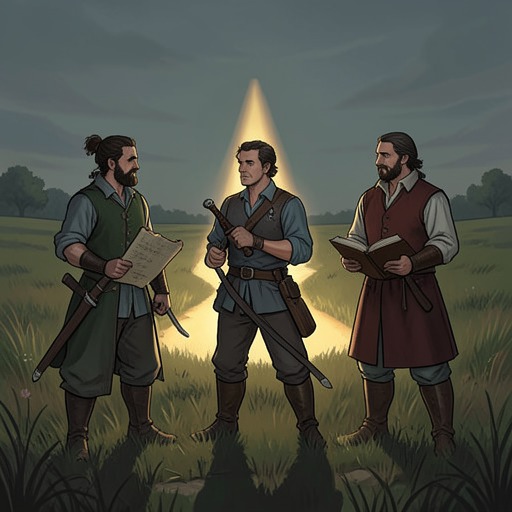
Fejedelem
Csongor és TündeFejedelem is the ruler among the three travelers who embody worldly pursuits in Csongor’s journey. His speeches first present sovereignty as a force that can command armies and remake nations; later, the same figure looks back on that power as irretrievable. The contrast makes him more than a symbol of worldly ambition: he is also its witness, able to describe the scale of dominion but unable to recover it.
Identity and Introduction
Fejedelem is identified as one of the three wanderers, alongside Kalmár and Tudós. Their appearance places his political ambition within a sequence of possible answers to the search for happiness: the ruler represents power and authority, while the other travelers embody different worldly pursuits. He enters not as a permanent guide to Csongor but as a figure whose account of his own experience gives that pursuit a human history.
The play marks his arrival with a stage direction announcing that he comes on. At that moment, he invokes Zeus, while allowing that the god might be called by another name, and turns immediately to the prospect of rule. His address to the deity makes his worldly position seem answerable to powers beyond himself, even as his next movement is toward the human instruments of command: his armies.
Power and Ambition
Fejedelem defines his authority through the reach of his forces. He summons his armies in the directions of sunrise and sunset and tells them to carry his power by their swords. Sovereignty is thus presented not as a private possession alone but as something extended outward through armed service. The image makes the ruler’s reach appear vast, yet it also shows that his might depends on the actions of others.
His ambition is set against the value of love. He declares that he would not exchange even a single love, not even its name, and would rather have his heart burn than be killed by frost. The contrast complicates his portrait: the ruler who can mobilize armies is not portrayed as wholly satisfied by domination. In his words, passionate feeling is preferable to coldness, so power and love stand as competing measures of what makes life worth enduring.
A further image sharpens the tension between greatness and limitation. Fejedelem speaks of not having to hide from the sunlight and of being lord of a small heap of crumbs within the great whole. The language joins a desire for unconcealed existence to an unexpectedly diminished image of dominion. However grand his position, he remains a small ruler within something larger, and the promise of sovereignty does not erase that disproportion.
Recollection and Loss
When Fejedelem appears again, his speech turns from command to memory. He recalls having given a signal after which one country became desolate, and having expressed a wish after which another arose. These paired claims make his former authority seem capable of destruction and creation alike: a gesture could empty a realm, while a desire could bring a different one into being.
That recollection leads to the question of who can return his former power. Fejedelem describes the people of the past as children and their gods as puppets, then says that he raised those people and that they were puppets no longer. His account presents rule as more than military force: he claims to have transformed a population and its relation to belief. Yet this memory ends not in renewed command but in a demand for restoration, underscoring the distance between the power he once exercised and the position from which he now remembers it.
Relationships and Narrative Role
Fejedelem’s exchanges with Csongor’s party place political authority beside other responses to the pursuit of happiness. When he arrives, Balga urges silence because a wiser voice is about to speak; the remark frames the ruler’s entrance as a shift in attention toward the weight of experience. Fejedelem’s account then supplies a counterpoint to the continuing journey: the travelers encounter not an abstract definition of sovereignty but a ruler looking back on what his power could accomplish and what it cannot give back.
The play’s contrast between Fejedelem’s martial command and his later retrospective question gives his episode its particular force. His armies once carried his authority in every direction; his memory can still name the emptied country, the newly raised one, and the people he says he formed. But recollection is not recovery. Through that reversal, Fejedelem represents worldly rule as immense in its effects and uncertain as a source of lasting fulfillment.